Ahidous
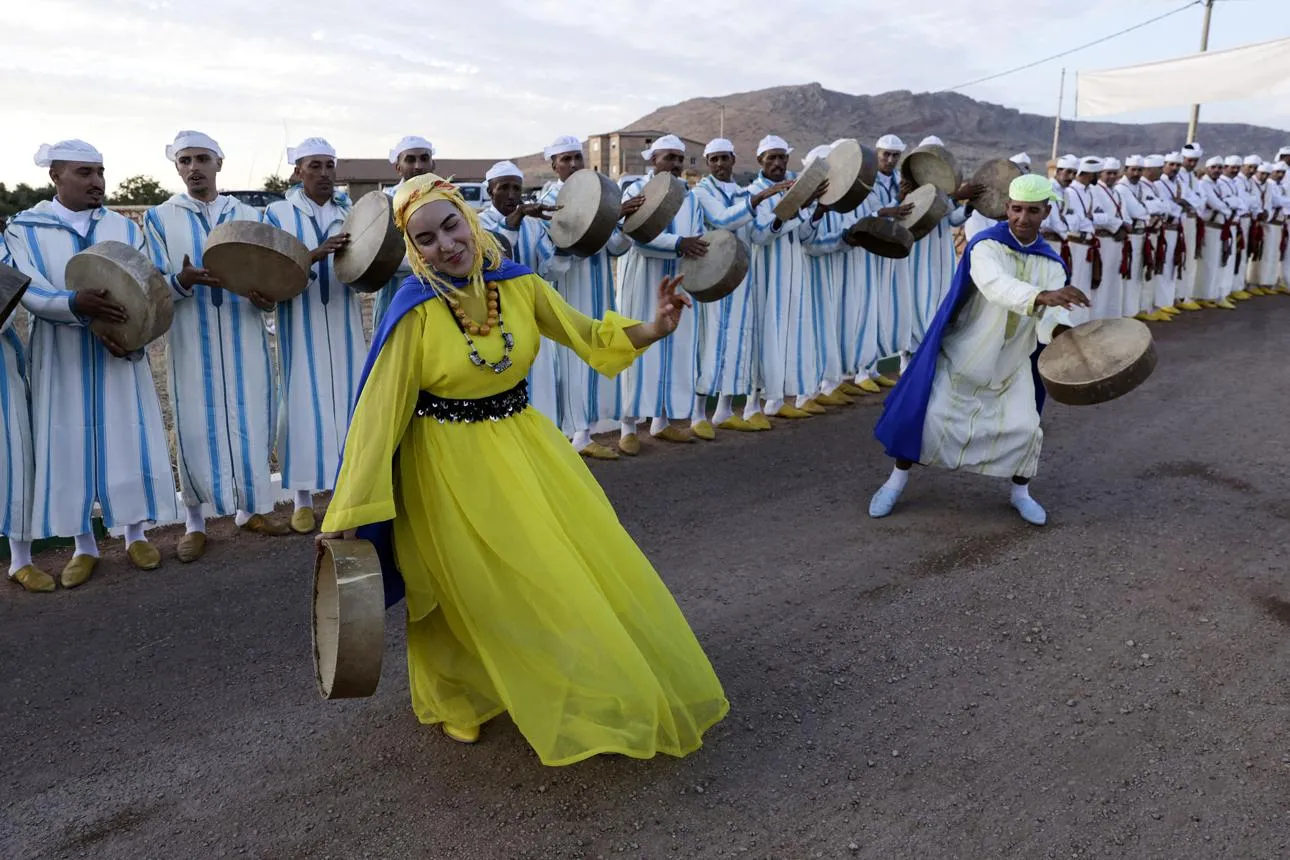
Ahidous is a traditional community dance of the Amazigh (Berber) in the Middle Atlas and other regions **Morocco**s. Men and women usually form a large semicircle or circle, move rhythmically together and accompany the dance with singing, drums and recitative alternating songs. Ahidous is not just entertainment, but an important expression of community, identity and cultural tradition.
Symbolically, Ahidous stands for the principle of collective harmony. The individual dancers do not emerge as isolated individuals, but rather become part of a common rhythm. The movement of the individual only gains meaning through integration into the group. This makes the dance a symbol of the connection between personal and communal identity.
Parapsychologically and symbolically, Ahidous can be understood as a form of rhythmic adjustment of consciousness. Repetitive movements, shared singing and synchronized posture often create a feeling of unity and connection. In many traditional cultures, such dances serve to embed individual experiences in a larger social and cosmic context. The rhythm acts as a mediating force between body, feeling and community.
A key feature of Ahidous is the interaction between voice and movement. Singing and dancing do not form separate elements, but rather a single form of expression. This creates a shared space of experience in which memories, stories, feelings and social bonds are kept alive.
In deeper symbolic meaning, Ahidous embodies the archetype of the Circle of Community. The circle is one of the oldest symbols of human connection: it has no center that stands above the others and no preferred direction. All participants contribute equally to the whole. Ahidous reminds us that identity comes not only from individuality, but also from belonging. The dance symbolizes the experience that through shared rhythm people can create something that is greater than the sum of its parts - a living field of community, memory and the present.