
Tree circles
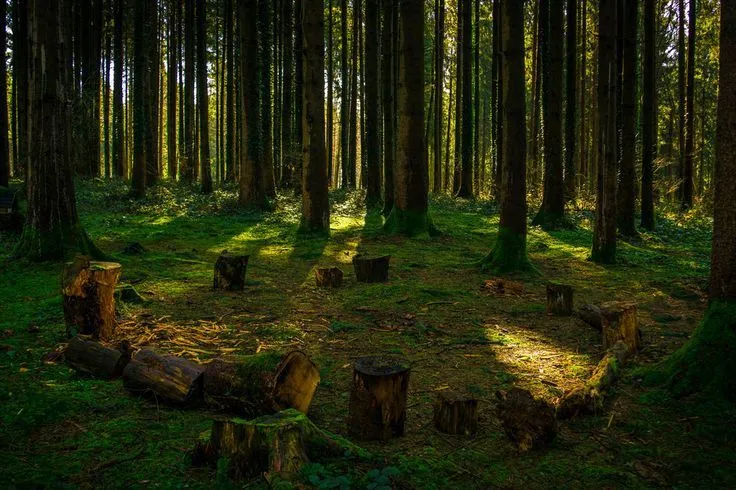
Tree circles refer to ring-shaped or circular arrangements of trees that function as a symbolic condensation of space. Whether deliberately planted, naturally formed, or perceptually constructed, tree circles are experienced as places of distinct quality—contained, gathered, and different from the surrounding forest.
Symbolically, tree circles represent natural order without architecture. The circle creates an inside and an outside without erecting walls. It marks a space of concentration where direction, time, and attention are perceived differently. The tree acts as a vertical axis between earth and sky, while the circle provides horizontal cohesion.
Esoterically interpreted, tree circles are liminal spaces of nature where presence is intensified. They do not invite action, but alignment. Humans enter not as designers, but as guests. Tree circles call for a posture of pausing, listening, and fitting into a greater order.
On a deeper symbolic level, tree circles stand for the memory of landscape. They appear as inscribed patterns, recalling ancient gatherings, rituals, or unconscious repetitions without fixing them historically. Tree circles are images of the interplay between growth and boundary, freedom and form—natural mandalas that require no function to be effective.