Gjöll
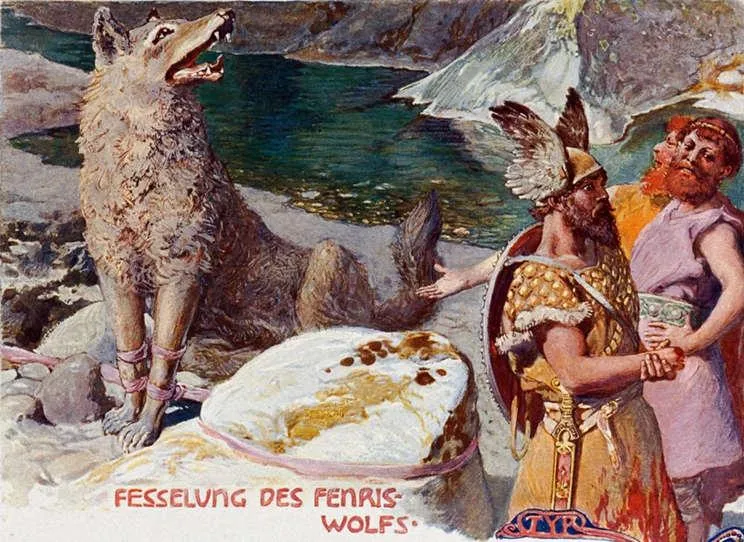
Gjöll in Nordic mythology is the huge stone slab or rock anchorage on which the gods placed the wolf Fenrir after binding him with the magic band Gleipnir. The myth reports that Fenrir lived on the island Lyngvi in the lake Ámsvartnir was bound. To prevent his release, the shackles were anchored deep in the earth and secured with the Gjöll stone slab.
The stone slab should not be confused with the river of the same name, Gjöll, which flows in the Nordic underworld. Here Gjöll refers to a solid anchor point that holds back the irrepressible power of Fenrir.
Symbolically, Gjöll stands for the principle of the binding of chaos. In mythology, Fenrir embodies a power that even the gods fear. He stands for those forces that want to destroy existing orders and evade any control. The stone slab therefore symbolizes the need for a solid foundation to limit such forces.
Parapsychologically and symbolically, Gjöll can be understood as an image for the anchoring of repressed or destructive energies. In many myths, threatening powers are not destroyed, but rather bound. As a result, they continue to exist, but outside the usual sphere of influence. The binding of Fenrir is reminiscent of psychological ideas according to which certain drives, fears or shadow forces do not have to be eradicated, but rather must be controlled and integrated.
It is particularly significant that, despite all the security measures, Fenrir ultimately does not remain permanently bound. In the myth, he will break free duringRagnarök. This gives Gjöll a tragic dimension: even the strongest order only lasts temporarily. What is bound remains there and can break out again at a later time.
In a deeper symbolic meaning, the Gjöll stone slab embodies the archetype of the foundation against dissolution. It represents those internal and external structures that limit chaos and maintain the balance of the world. At the same time, it reminds us that all order is fleeting. The binding of Fenrir does not symbolize the final victory over Chaos, but merely its temporary containment. Gjöll thus becomes a symbol of the human effort to give form, boundaries and direction to the destructive forces of life.