


H. W. L. Poonja
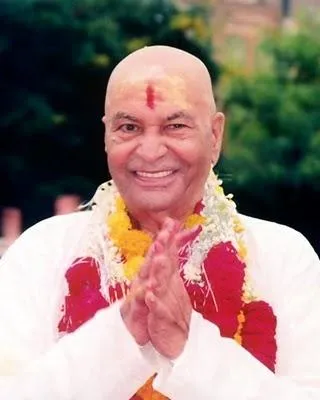
H. W. L. Poonja (1910–1997), commonly known as Papaji, was an Indian spiritual teacher of the Advaita Vedanta tradition. He is considered one of the most important representatives of the modern teaching of non-duality and was a direct student of Ramana Maharshi. Through his satsangs in Lucknow, he influenced numerous Western and Eastern teachers, including Gangaji.
Papaji's spiritual path began in the tradition of bhakti, the devotional worship of God. Despite intense religious experiences, the question of ultimate truth remained open for him. The meeting with Ramana Maharshi became the turning point in his life. Ramana drew his attention to the question: "Who am I?" From this encounter developed Papaji's central teaching of immediate self-knowledge.
Symbolically, Papaji stands for the principle of direct liberation. Unlike many spiritual systems that emphasize long paths of practice, he held that man's true nature was already fully present. Liberation therefore does not have to be achieved, but only recognized. Truth is not a future goal, but the always existing basis of all experience.
Parapsychologically-symbolically, Papaji is remarkable in that he attached little importance to extraordinary experiences. He viewed visions, energies, siddhis, mystical states or paranormal phenomena as temporary appearances of the mind. For him, the real knowledge did not lie in extraordinary experiences, but in recognizing the person who perceives all experiences. In doing so, he shifted the focus from the contents of consciousness to its origin.
In his conversations, Papaji often emphasized the possibility of instant knowledge. The seeker does not have to become anything, achieve anything and do not have to acquire a new identity. Rather, all striving maintains the illusion that something is missing. His teaching therefore aimed at an immediate recognition of the freedom that already existed.
In a deeper symbolic meaning, Papaji embodies the archetype of the teacher of the immediate present. It stands for the insight that what you are looking for already exists and that the greatest barrier is often the search itself. His message is reminiscent of a central motif of mysticism: the truth does not lie in the distance, but in the origin of present consciousness. Papaji thus symbolizes the radical simplicity of spiritual knowledge - the discovery of what was never lost.




Unlocking the Mysteries: A Comprehensive Guide to Tarot & Oracle Cards
Read More