Izebel
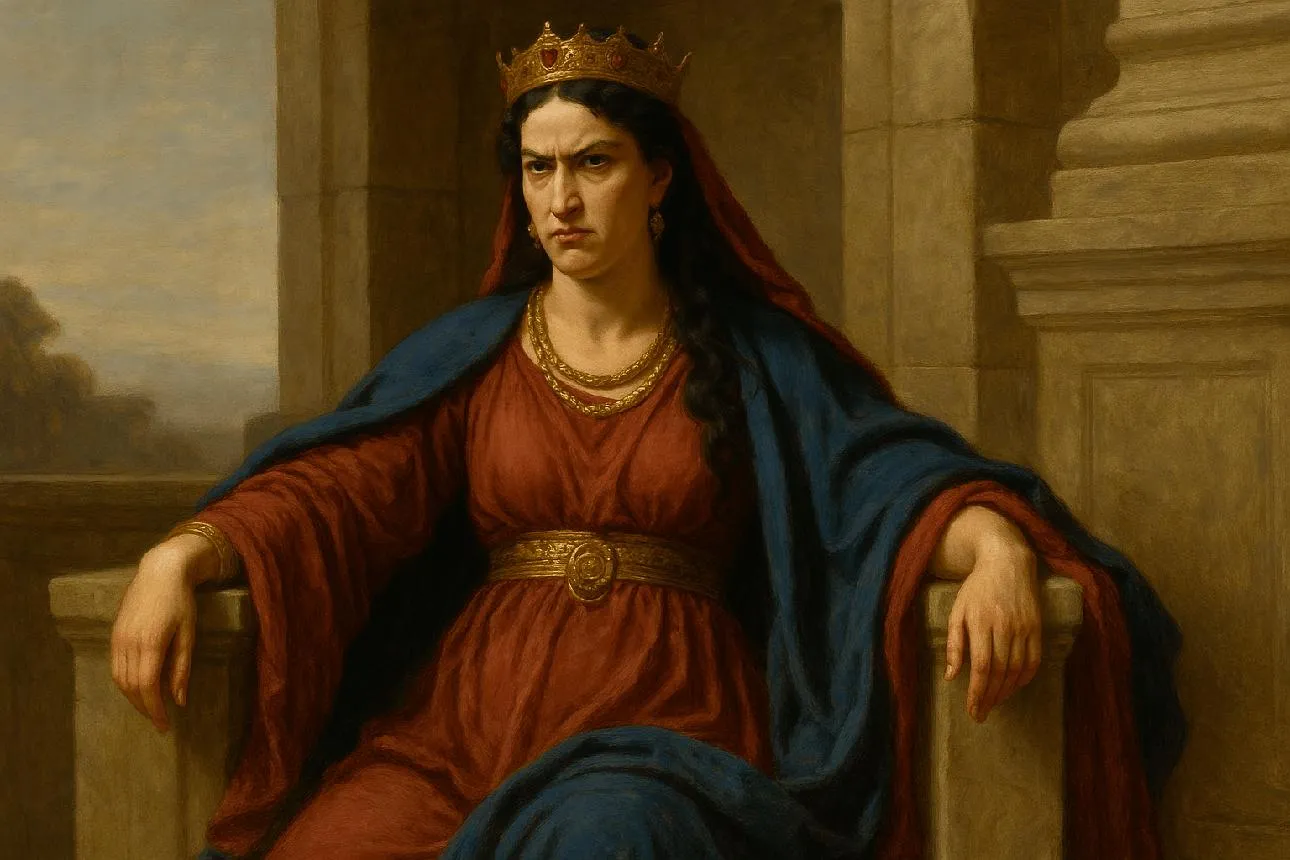
Jezebel (mostly German Jezebel or Jezabel) is one of the most famous and controversial female figures in the Old Testament. She was the daughter of the Phoenician king Ethbaal and became the wife of the Israelite king Ahab. Their story is told primarily in the Books of Kings.
In the biblical account, Jezebel promoted the worship of the god Baal and thereby came into sharp conflict with the prophets of Israel, especially with Elijah. She is considered a power-conscious, determined and religiously controversial ruler.
The prophet Elijah spoke a message of judgment against them. Later, during the overthrow of Jezebel, Jezebel was thrown out of a window. When they tried to bury her body, all they found was the skull, feet and hands, as dogs had eaten the rest of the body. This was understood as a fulfillment of prophecy. The biblical story reports this explicitly. Books of Kings
Symbolic meaning
Symbolically, Jezebel stands for the motif of hubris power, i.e. a rule that ignores religious or moral boundaries. In the Judeo-Christian tradition she often became the embodiment of seduction, manipulation and abuse of power.
Parapsychologically-symbolically she appears as an archetype of the Shadow Queen. She embodies the dark side of authority: control, ambition, dominance and the temptation to use spiritual or political power for personal gain.
The dogs also have strong symbolic power in the story. In the Ancient Near East they were often considered scavengers and were associated with uncleanness. Jezebel being eaten by dogs therefore symbolizes the complete dissolution of worldly power and the transience of human greatness. What appears untouchable is ultimately subject to decay.
Deeper symbolic interpretation
In a deeper symbolic meaning, Jezebel embodies the archetype of the overthrown ruler. Her story is about the transience of power and the consequences of identifying with domination and control. The fall from the window symbolizes the fall from an elevated position, while the dogs represent the return of everything earthly to the cycle of nature.
Regardless of the historical person, "Jezebel" became in later religious traditions a symbol of those forces that operate through charisma and power but lose their connection to a higher order. Their story is a reminder that in the symbolic language of many myths and religions, no worldly power can last forever