Lu
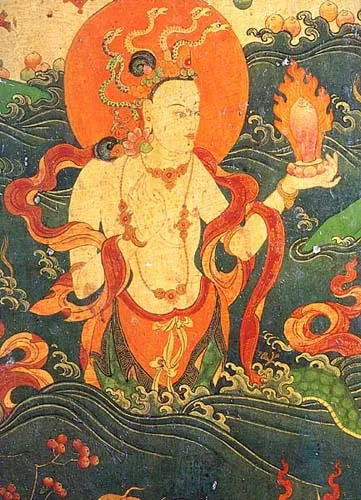
Lu refers, in ancient Tibetan cosmology, to a class of serpent- or dragon-like beings associated with water, depth, moisture, and hidden life force. Lu are neither demons nor high gods, but powerful beings of place and order, bound to springs, lakes, rivers, and subterranean realms.
Symbolically, the serpentine form of the lu represents the cyclical, winding principle of life. The snake embodies motion without linear goal, power without visibility, transformation without ascent. Lu carry both fertility and illness: when respected, they sustain balance; when disturbed, they respond with disruption. Their form expresses that life does not only rise upward, but circulates in depth.
Esoterically interpreted, lu embody the invisible sensitivity of the world. They react to carelessness, boundary violation, and lack of measure. Rituals in ancient Tibet therefore aimed not at controlling the lu, but at appeasement and rebalancing. The relationship is not moral, but ecological: right and wrong are revealed through consequence.
On a deeper symbolic level, lu stand for a reality in which nature is not neutral. Their serpentine form makes clear that order is fragile and responsive. Lu remind us that water, soil, and depth possess their own dignity—and that human action produces resonance in the unseen.