

Mu
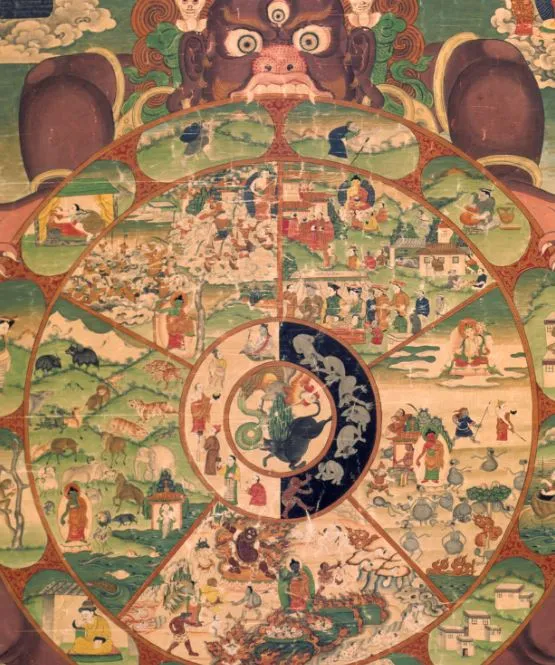
Mu refers, in ancient Tibetan cosmological understanding, to the primordial state before the world, a pre-temporal darkness that is neither chaos nor emptiness. Mu is not nothingness, but an undifferentiated ground from which order may emerge. It is the condition in which nothing has yet been separated, named, or oriented.
Symbolically, mu represents the before-distinction. Within mu there is neither sky nor earth, neither light nor shadow, neither motion nor stillness. Everything is contained, yet nothing is singled out. Mu is therefore not absence, but complete indeterminacy. It carries the world without revealing it.
Esoterically interpreted, mu is the supporting background of all later manifestation. It does not act, intervene, or intend. Precisely for this reason it is stable. Everything that arises emerges from mu and remains permeated by it. Mu is not overcome, but obscured when the world appears.
On a deeper symbolic level, mu expresses a cosmology in which origin is not explained, but acknowledged. Mu resists language, ritual, and control. It reminds us that every order rests upon something that itself remains unordered—and that beginning is not an event, but a continuous ground state beyond fixation.