
Puja
Puja
Sacred Offering • Ritual of Devotion • Bridge Between Human and Divine
Puja (Sanskrit: पूजा, “worship,” “honoring,” “offering”) is a central ritual in the spiritual traditions of India — especially Hinduism, Buddhism, and Jainism.
It is the art of sacred devotion, a living dialogue between the devotee and the Divine — understood as deity, cosmic force, ancestral presence, or inner Self.
The Essence of Puja
A Puja is not merely an outer ceremony.
It is an expression of:
-
devotion (Bhakti)
-
purification
-
energetic attunement
-
concentration of awareness
-
awakening of the inner presence
Through the ritual, the outer action becomes a mirror of the inner state.
It teaches that the Divine is not only worshipped but experienced.
Symbolic Elements of Puja
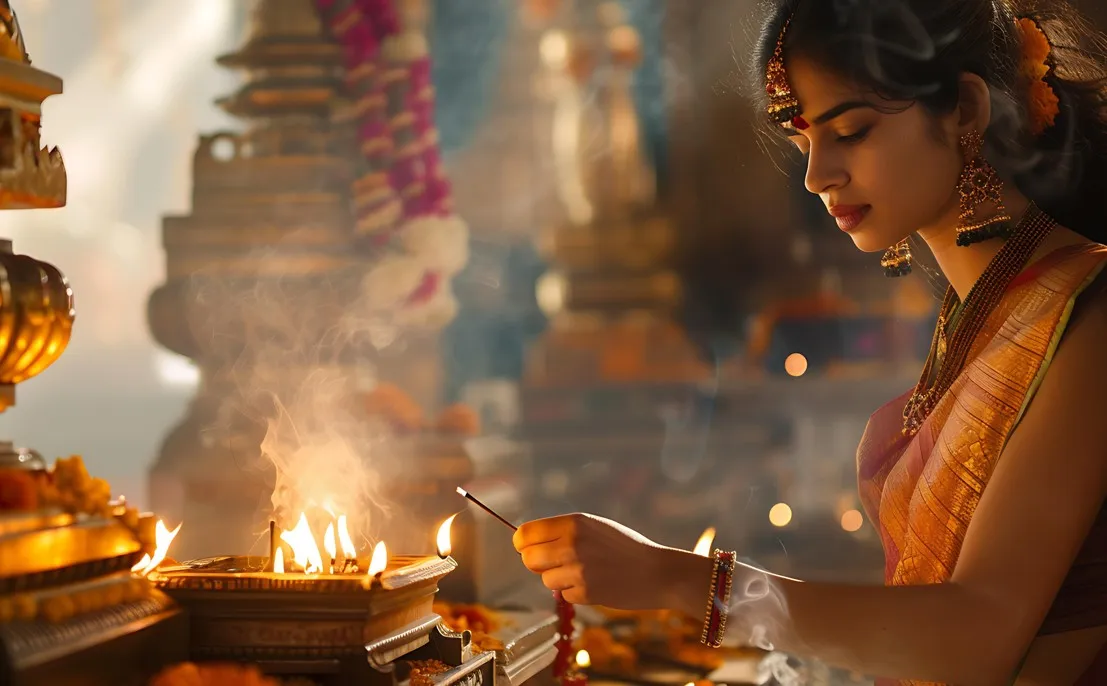
Though a Puja can be simple or elaborate, it usually contains symbolic offerings such as:
-
Light (Dīpa) – illumination, removal of darkness
-
Water (Arghya) – cleansing, flow of life
-
Flowers (Puṣpam) – beauty, impermanence, devotion
-
Incense (Dhūpa) – the rising of prayer, purification of space
-
Food (Naivedyam) – sharing, abundance, surrender
-
Sound (Bell, Mantra) – vibration that awakens the divine presence
Each offering symbolizes both an aspect of the soul and an aspect of the deity.
Forms of Puja
1. Home Puja (Gṛha Puja)
A quiet, intimate ritual at a household altar
— for purification, blessing, protection, harmony.
2. Temple Puja (Mandir Puja)
A priest performs the ritual with:
-
mantra recitation
-
consecrated fire
-
ritual gestures
It is powerful due to the consecrated atmosphere of the temple.
3. Inner Puja (Mānas Puja)
A purely mental or meditative offering — visualized within the heart.
This is often considered the highest form, as it arises directly in consciousness.
Esoteric Significance
Puja is a transformative ritual that:
-
invokes and concentrates sacred energy,
-
purifies the body and opens the subtle channels,
-
harmonizes the practitioner with cosmic forces,
-
cultivates receptivity to grace, peace, and clarity,
-
creates a sacred inner space where vision and insight arise.
It is a path of inner alchemy:
In the act of worship, the devotee becomes more like the One they worship — radiant, open, serene.
Symbolic Archetypes within Puja
-
Lighting the lamp → Awakening of consciousness
-
Offering flowers → Giving up desires and ego-patterns
-
Presenting water → Surrender of emotional currents
-
Burning incense → Purification of thoughts
-
Chanting mantras → Activation of subtle energies
-
Receiving Prasad → Returning to the world touched by grace
Puja is an energetic cycle, a ritual dance between offering and receiving.
Spiritual Essence
Puja is the moment where:
**The soul bows before the Source,
and the Source blossoms within the soul.**
Through outer action, inner union is revealed
— a union rooted in light, devotion, and stillness.
Keywords:
Puja, Bhakti, Devotion, Sacred Offering, Ritual, Mantra, Divine Attunement, Eastern Mysticism

Unlocking the Power of Spiritual Healing: A Journey to Wholeness and Well-Being
Read More