

René Warcollier
René Warcollier was a French engineer, inventor and parapsychologist of the 20th century, best known for his extensive Experiments on telepathy and image transmission became known. His most famous experiments involved one person looking at an image while another, spatially separated, tried to receive and reproduce impressions or drawings. Warcollier devoted decades to studying such phenomena and later headed the French Institute of Metapsychics.
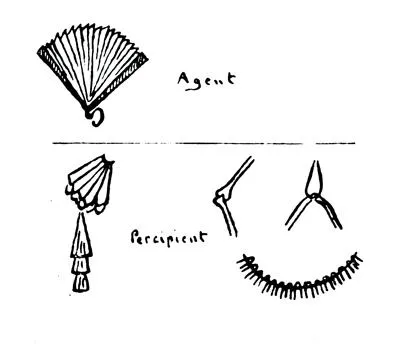
Symbolically, Warcollier stands for the principle of wandering images. He was less interested in the idea of a mechanical “thought transfer” than in the question of how inner contents change shape when they pass between people. In his investigations, it was noticeable that the images received were often not identical, but rather appeared symbolically shifted or reshaped: a circle became a sun, a ladder became a tower, an object became a related metaphor.
Parapsychologically-symbolically, Warcollier can be understood as a researcher of the transformation of the material of consciousness. For him, telepathy – if it existed – was not a photographic copying process. The receiving consciousness processes impressions through its own memories, emotions and unconscious structures. This makes his view unusual: the psyche does not appear as a passive receiver, but rather as an active translator of the invisible.
In a deeper symbolic meaning, René Warcollier embodies the idea that communication possibly goes deeper than language itself. People transmit not only words, but images, moods and structures. Even if one does not view telepathy as an objective phenomenon, his work remains significant: it points to the possibility that people understand each other not only through direct signs, but also through resonance spaces of imagination. Warcollier reminds us that an exact copy may never be created between sender and receiver - but rather a transformation of the sense.