Uroboros
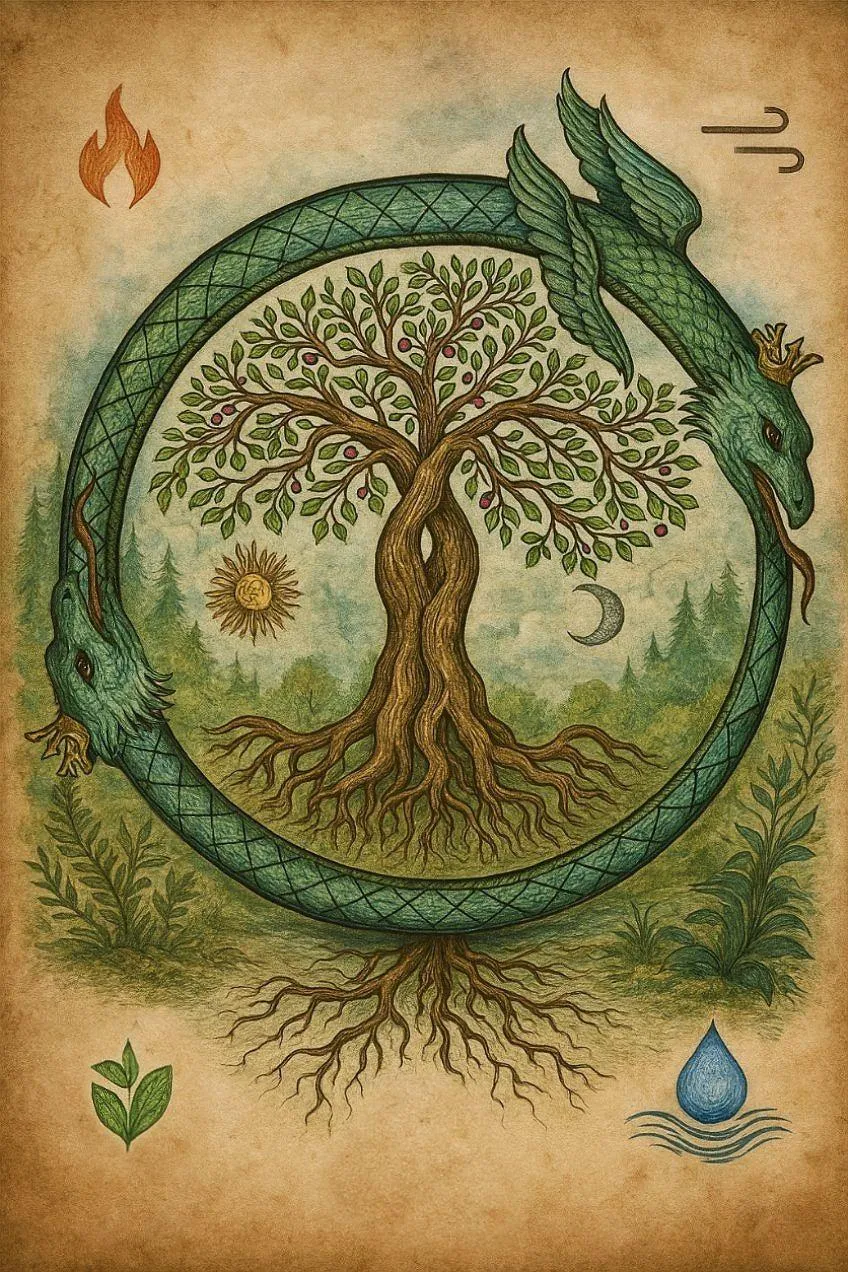
Uroboros (Ouroboros)
The serpent devouring its own tail • Symbol of eternity • Circle of death and rebirth
The Uroboros (Greek: oura = tail, boros = devouring) is one of the oldest and most profound Symbols of human history. It shows a snake or a dragon holding its own tail in its mouth, forming a circle.
The Uroboros appears in:
- Ancient Egypt
- Gnosis
- Hermetics
- Alchemy
- Kabbalah
- Mysticism and esotericism
and is considered a universal symbol of unity and the eternal cycle.
Historical origin
The oldest known depictions come from ancient Egypt. There the Uroboros symbolized:
- the infinity of creation
- the cosmic cycle
- the unity of beginning and end
It was later adopted by Greek, Gnostic and alchemical traditions.
Esoteric meaning
The Uroboros embodies:
1. Eternity
No beginning, no end.
Everything arises from itself and returns to itself.
2. Death and rebirth
The circle symbolizes:
- Die
- Transformation
- Renewal
- Rebirth
Every end already contains the seed of a new beginning.
3.Unity of opposites
The Uroboros unites:
- Light and Darkness
- Mind and matter
- Life and Death
- Creation and Dissolution
It stands for the realization that opposites are part of a larger whole.
4.Self-creation
The Uroboros symbolically feeds on itself.
It becomes an image for:
- Self-Transformation
- internal development
- spiritual autonomy
The Uroboros in Alchemy
In alchemy, the Uroboros symbolizes:
The One is All
It stands for the process of transformation in which the impure is purified and transformed into higher forms.
The circle of the Uroboros describes:
- Resolution
- Cleaning
- Union
- Completion
Psychological significance
The psychologist Carl Gustav Jung saw the Uroboros as an archetypal symbol of the self.
He embodies:
- the wholeness of the psyche
- the cycle of inner development
- the union of conscious and unconscious forces
Symbolism
Element: Aether
Symbols:
- Snake
- Dragon
- Circle
- Wheel
Qualities:
- Eternity
- Wholeness
- Conversion
- Infinity
Spiritual Essence
"The end is the beginning,
and the beginning already rests in the end."
The Uroboros reminds us that all life runs in cycles and that every change is part of a larger, eternal circle.
Keywords
Uroboros • Ouroboros • Snake • Alchemy • Eternity • Rebirth • Hermeticism • Wholeness • Carl Gustav Jung • Circle of Life