Displacement
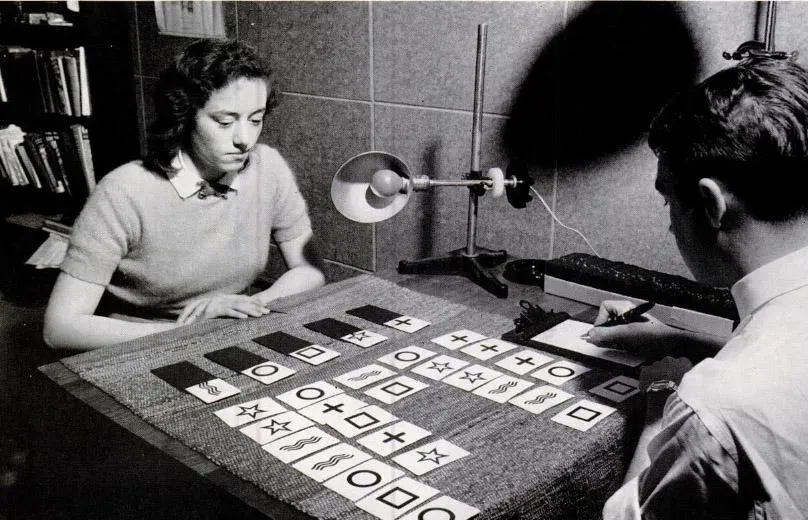
The shift refers to a special phenomenon in classical parapsychology that was observed in card and telepathy experiments. The term was notably used byHereward Carrington. It was noticeable that test subjects often did not name the card that was actually drawn, but rather the card that was immediately before or after in the order.
With the so-called Zener cards (often incorrectly called "ten cards") - circle, cross, wavy lines, square and star - it was shown in some series of tests that the hit rate was statistically inconspicuous, but the answers appeared to be systematically shifted by one position. For example, instead of card 5, card 4 or 6 was mentioned.
Symbolically, the shift stands for the principle of incomplete agreement. The information does not appear to be completely lost, but reaches consciousness in an altered form. The phenomenon is reminiscent of a poorly adjusted receiver that picks up the signal but does not tune exactly to the right channel.
Parapsychologically and symbolically, the shift was interpreted as a possible indication that extrasensory perception - if it exists - does not work like a photographic transmission. The information received could be changed, distorted or rearranged as it passes into consciousness. Carrington considered such systematic errors to be just as interesting as direct hits because they seemed to indicate a structure of the error.
Psychologically, the shift can also be understood as an effect of expectation, memory processes or unconscious pattern formation. Precisely because the answers were not distributed randomly, but followed a certain order, the phenomenon was intensively discussed by both parapsychologists and critics.
In a deeper symbolic meaning, the shift represents the realization that information is rarely transmitted unchanged. There is a space of transformation between perception and consciousness. Receiving a message does not automatically mean its correct understanding. The shift therefore symbolizes the difference between signal and interpretation – between what arrives and what is made of it. It reminds us that error does not always mean absence of information, but sometimes aaltered form of information.