
The pentagram made of chalk
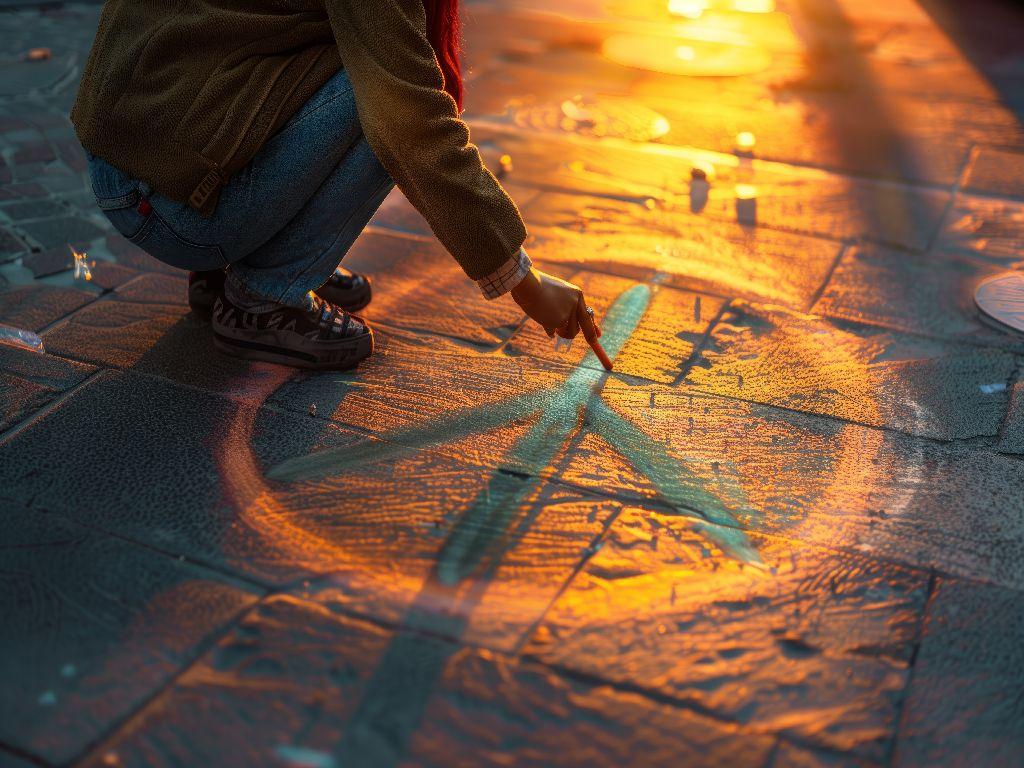
The Chalk Pentagram
The school was old enough to have secrets, and young enough not to have hidden them well yet. In the science room, where peat moss floated in jars and skeletons clattered in its cabinets, three students found a chalk pentagram one evening. Not large, not dramatic. Carefully, almost tenderly drawn. In the corners were symbols that seemed to have stopped halfway to letters.
"Who was that?" whispered Mina, who wanted to believe anything that could be whispered. "Maybe a ritual," murmured Jarek, pretending he wasn't nervous. Only Sumi, who thought in numbers, knelt down and examined the lines. "It's not neat," she said. "But intentional. Like a question."
They sat in a circle, not quite on the lines, out of respect for things they didn't understand. "If we call out something, will it come?" asked Mina. "Maybe it's calling anyway," said Sumi. "Maybe the pentagram isn't for calling. It's for answering."
They decided not to call. They decided to listen. Each placed an object in the middle: Mina her hair clip, Jarek a wrench, Sumi a calculator. "This is silly," said Jarek, "but in a good way." Outside, it began to rain, softly. Inside, there was a hum, like an old television turned off. Minutes passed in which nothing happened and a lot happened.
Mina thought of her grandmother, who had once told her that every person had five ends like a star: head, two hands, two feet. "And the middle?" Mina had asked. "It's not an end," her grandmother had laughed. "It's the bottom." Now, in the science room, Mina placed her hand on the floor. The chalk was rough. "I don't want to be brave," she whispered into the air. "I just don't want to be cowardly."
Jarek thought of his father, who spoke to metal in the workshop as if it were a stubborn animal. "Everything has a nature," he had said. "Your job is not to break it. Your job is to work with it." Jarek looked at the wrench and felt as if he had introduced an Old Friend who knew his own ways.
Sumi counted the angles. Five vertices, each angle 36 degrees. Five times 36 is 180. A circle of angles. "Impossible, and yet," she murmured. She thought of proofs that one doesn't write down because one knows them like breathing. And then, very quietly, she heard a voice without language saying: "Order is kind. But kindness is not order."
The rain grew heavier. A pipe crackled in the hallway. Somewhere, someone who was late laughed. The pentagram remained chalk, remained a line. And yet, perhaps only because three people sat quietly and didn't demand anything, the room changed. Invisibly. It was tangible, like the second before you understand something. In the jars, the mosses seemed to move closer to the glass. The skeleton stood upright; but it always did. Mina looked at Sumi, Sumi looked at Jarek, and the fear they had brought with them wasn't gone—but she was no longer alone.
"I think," Sumi said finally, "that this sign isn't a door. It's a mirror. Not for faces. For attitudes." Jarek, who usually laughed when things got serious, nodded. "Then... we leave something here? Not as an offering. As a promise."
They turned out the light but left the door ajar. The three objects remained in the pentagram. The next morning, the janitor found them, frowned, and placed everything on the teacher's desk. The chalk star had survived the night's rain, even though the windows were leaking. Later, in class, Miss Rivas saw the pentagram, sighed, picked up a brush—and paused. She left the chalk there. Instead, she wrote on the board: "Pentagram: Protection, Measure, Human." Then she turned around and said, "Today we're talking about forms that think."
The school remained both old and young. The pentagram was eventually cleaned. But the three who had sat there carried something with them: a faint but reliable feeling that magic doesn't come from what one calls forth, but from what one is willing not to banish.