Emergence theory
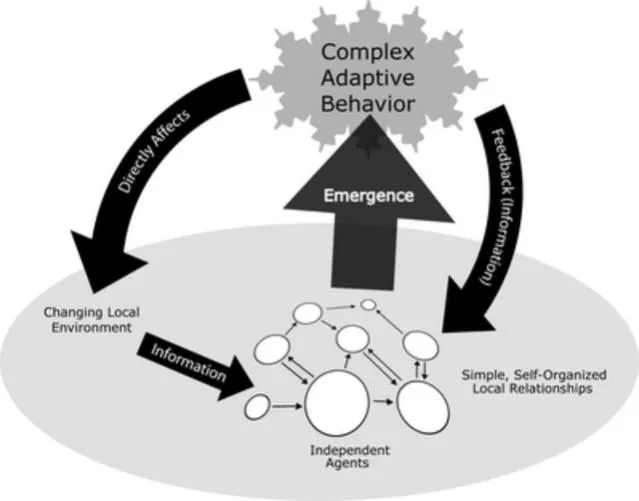
The Emergence Theory is a philosophical and scientific concept that explains how the interaction of many simple elements can create new properties that do not exist at the level of the individual parts. The word emergence comes from the Latin emergere ("to appear", "to come forward"). What is meant is the appearance of new qualities that only become visible at a higher organizational level.
Classic examples are life, which arises from the organization of inanimate matter, or consciousness, which arises from the interaction of billions of nerve cells. No single nerve cell has consciousness; Nevertheless, a new phenomenon appears at the level of the entire brain: subjective experience.
Symbolically, the emergence theory stands for the principle of the emergence of the whole from the multitude. The whole is more than the sum of its parts. New orders, patterns and properties emerge without being able to be completely reduced to their individual components.
Parapsychologically and symbolically, emergence theory is of particular importance because it enables an alternative view of many extraordinary phenomena. Rather than viewing consciousness as something supernatural, emergence theory asks whether complex states of consciousness, intuitions, or collective phenomena could emerge from highly complex interactions. Some researchers see this as a possible approach to explaining previously poorly understood phenomena of consciousness without resorting to supernatural assumptions.
In the philosophy of mind, emergence theory plays an important role in the discussion about the relationship between the brain and consciousness. She tries to find a middle ground between strict materialism and dualism. Consciousness is understood neither as an independent substance nor as a mere illusion, but as an emergent property of complex systems.
In a deeper symbolic meaning, emergence theory embodies the archetype of creative wholeness. It reminds us that reality is organized on different levels and that each level can give rise to new possibilities. Cells arise from molecules, organisms from cells, societies and cultures from organisms. Each stage brings out properties that were not visible before.
The emergence theory symbolizes the insight that development does not only mean repetition, but also new creation. It points to the secret that something qualitatively new can arise from the interaction of many simple processes - something that is neither completely predictable nor completely reducible to its components.