

Sahaja Yoga
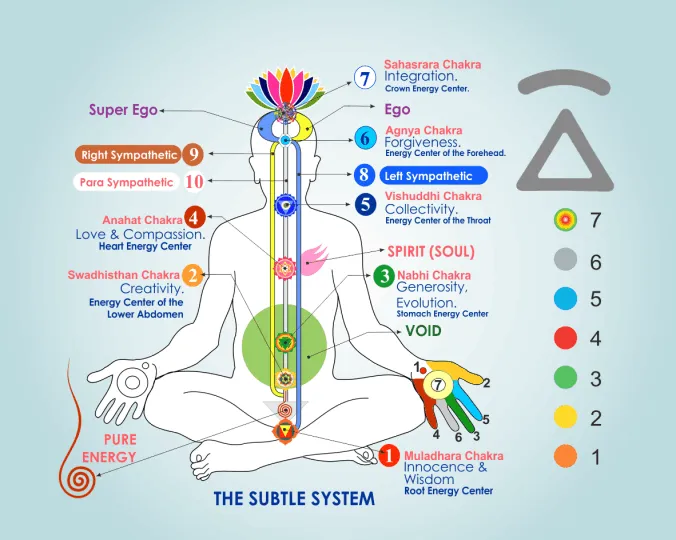
Sahaja Yoga refers to a spiritual teaching and practice centered on spontaneous self-realization. The term “sahaja” roughly means innate or effortless: realization is not achieved through striving, but uncovered. Sahaja Yoga views spiritual awakening as something already present within the human being, requiring activation rather than construction.
Symbolically, Sahaja Yoga represents the principle of inner naturalness. Truth is not a distant goal, but a resting state hidden beneath layers of conditioning. The practice does not aim at ecstasy or extraordinary states, but at stabilization, composure, and inner balance. The extraordinary is meant to settle into the ordinary.
Esoterically interpreted, Sahaja Yoga is a teaching of gentle order. Transformation occurs not through force of will, but through allowance. The imagery of rising inner energy functions less as spectacle than as a metaphor for the alignment of inner levels. Stillness, clarity, and sobriety are regarded as signs of maturity.
Sahaja Yoga thus promotes a spiritual ideal opposed to the heroic seeker. It emphasizes simplicity, self-observation, and collective grounding. Realization is not individually conquered, but understood as a shared possibility, unfolding where the ego ceases to propel itself.