Folkwang
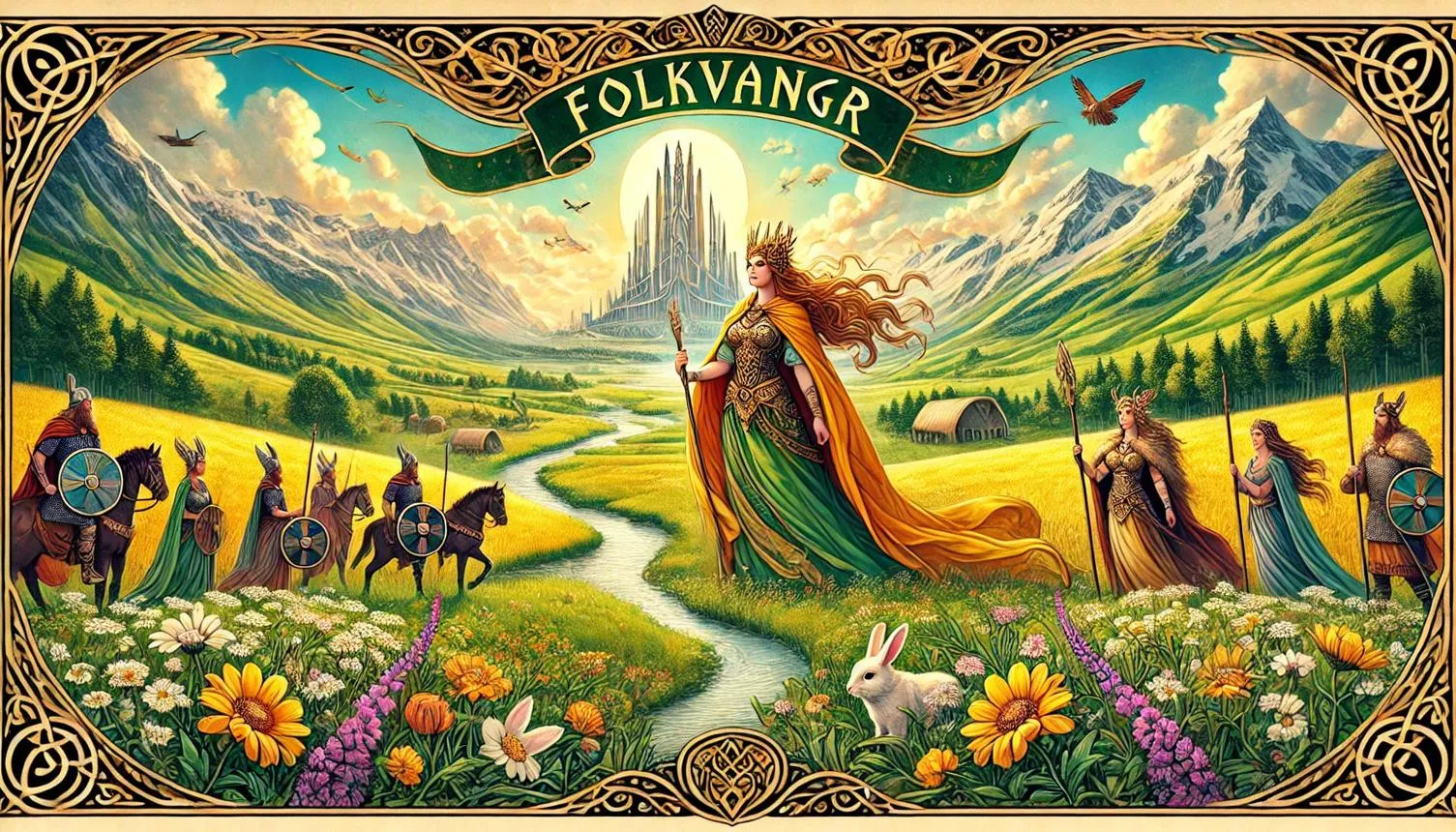
Folkwang or Folkvangr ("field of the people" or "field of the army") is in Nordic mythology the heavenly realm of the goddess Freyja. According to the traditions of the Prose Edda, Freyja receives half of all the warriors who died in battle. The other half enters the hall Valhalla of the god Odin.
In the center of Folkwang is the hall Sessrúmnir, which is described as Freyja's residence. Unlike Valhalla, which is often portrayed as a place of military preparation for Ragnarök, Folkwang has in many interpretations a more peaceful and at the same time more mysterious character.
Symbolically, Folkwang stands for the principle of mild reception of the fallen. While Odin represents the heroic and combative side of the warrior ideal, Freyja embodies love, fertility, beauty, magic and wisdom. Folkwang thus appears as a realm beyond where not only bravery, but also belonging and security play a role.
Parapsychologically and symbolically, Folkwang can be understood as an archetypal transitional space of the soul. It is one of the many mythical images of a kingdom between death and rebirth, between end and continuation. The fallen are not wiped out, but absorbed into a different form of existence. In this way, Folkwang symbolizes the idea that death is a transition and not absolute annihilation.
The connection to Freyja is particularly notable. She is considered a master of Seiðr, a form of Norse magic and divination. This gives Folkwang an additional dimension of wisdom, intuition and hidden knowledge. The kingdom becomes not only a place of residence for the dead, but also a symbol of spiritual transformation.
In a deeper symbolic meaning, Folkwang embodies the archetype of the healing afterlife field. It is the place where struggle and effort come to rest and the soul is absorbed into a larger context. The “Field of the People” symbolizes the return to a community that extends beyond individual life. Folkwang reminds us that the end of a journey can also be the entry into a new space of belonging. It stands for the hope that behind loss and death there is not emptiness waiting, but a deeper form of home.