

Terma
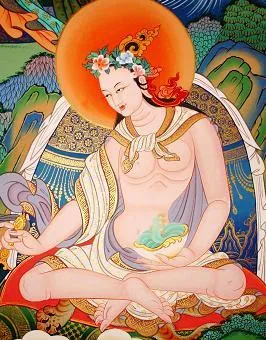
Terma (Tibetan གཏེར་མ་, literally “treasure”) refers in Tibetan Buddhism to hidden teachings intentionally concealed to be revealed at a later time, when beings and conditions are ripe. Termas are not accidental discoveries but time‑released revelations, designed to meet the needs of specific eras.
Symbolically, Terma represents the memory of awakening transmitted not linearly, but cyclically through remembrance. The teaching does not vanish; it rests—in rocks, lakes, space, or mind—until the right resonance calls it forth. In this sense, termas are less texts than responses to time itself.
Esoterically, termas are classified as outer termas (physical texts or objects), inner termas (visions, sounds, intuitive transmissions), and secret or mind‑termas that arise directly as realization within awareness. Those who reveal them are called tertöns—not authors, but rememberers whose minds align with the original intent of the teaching.
Padmasambhava is traditionally regarded as the principal originator of the terma tradition, concealing teachings to protect them from corruption and to revitalize the Dharma when needed. Thus, terma embodies living transmission: Dharma that awakens at the right moment.
Symbolic Layers:
-
Temporal: non‑linear transmission of wisdom
-
Psychic: remembrance of the primordial
-
Mystical: revelation beyond authorship
Key Images: sealed scrolls, rocks and lakes, visionary light, sudden insight, the act of discovery